Flexible Design
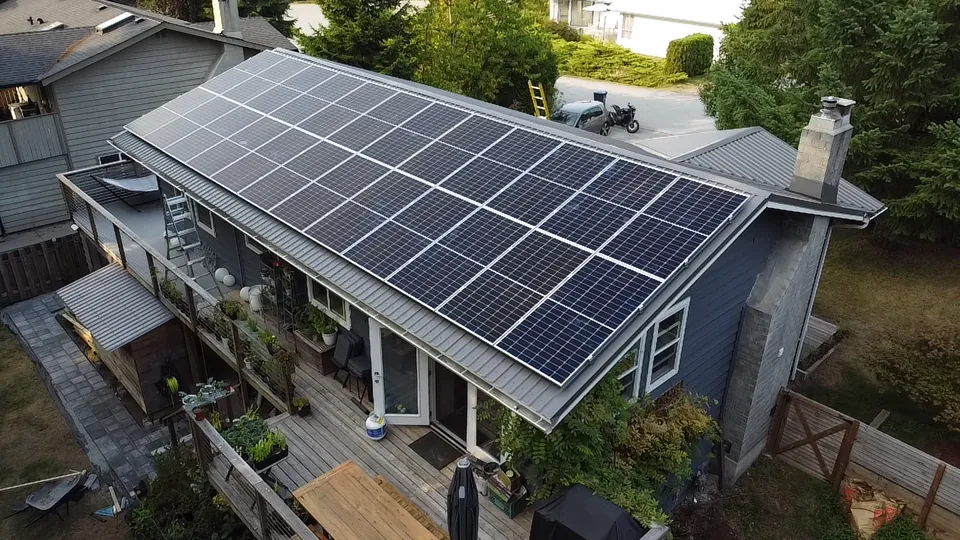
All AC design, no minimum system size. Can connect across multiple roof faces.
See below our answers to some of the frequently asked questions our clients would like to know.
If you don’t see the question or answer that you are looking for, feel free to send us your question on the form below and we will gladly respond as soon as possible.
Eligible homeowners can claim $1,000 per kW of installed solar capacity, up to $5,000, and a further $500 per kWh of paired battery storage, up to $5,000 with Peak Saver enrolment. Both are capped at 50% of the installed cost. Commercial and multi unit buildings can claim up to $10,000 on the solar side. See every incentive available now.
As a renewable energy source, solar has an important role in reducing greenhouse gas emissions and mitigating climate change, which is critical to protecting humans, wildlife, and ecosystems. Solar energy can also improve air quality and reduce water use from energy production. That occurs by reducing our reliance on foreign oil and fossil fuels.
Solar power is pollution free and does not emit greenhouse gases which is why it is one of the cleanest sources of energy.
Energy consumption is measured in kWh monthly or bi-monthly on your utility statements. BC Hydro allows online access or you may receive mailed copies. Ideally you would check your annual production by viewing your consumption over a 12-month period to reflect the seasons. This would enable you to install a system that would meet your annual needs by overproducing in the summer to compensate for the winter months.
Net metering is designed for those who generate electricity for personal consumption. It allows you to power your home or business with renewable energy in a self-sufficient way, but with the flexibility to rely on the grid if you need it.
Net metering, Rate Schedule 1289, closed to new customers on 1 July 2026. New solar customers go onto self generation service, Rate Schedule 2289, where BC Hydro buys your excess generation at 10 cents per kWh and credits you every billing cycle rather than once a year. Existing net metering customers stay on their rate for ten years from their service start date.
Solar energy is energy from the sun in the form of radiated heat and light. The sun’s radiant energy can be used to provide lighting and heat for buildings and to produce electricity. That means that even if panels aren’t under direct sunlight they are still capable of producing energy through irradiation. Having said that, solar panels are not capable of producing energy during the evening. Just to be clear.
All systems installed in BC can handle a certain snow load based on the geographic area in which you are located. Our solar technicians install systems accordingly. Solar panels have a sleek surface which is much more efficient for clearing snow naturally opposed to shingled roofs for example. In the lower mainland our annual snowfall is low, however rest assured snow will clear naturally from your system and there is no need to panic if panels do become covered in snow.
Depending on the size of your system, it may be enough to cover part of, or go net zero. By providing our solar experts with your energy consumption through previous BC Hydro bills, we will be able to design a system that perfectly suits your energy requirements. New solar customers are credited 10 cents per kWh for what they export under self generation service, and a battery lets you use more of your own power rather than exporting it.
Let nature look after your panels for you. While rain may not be ideal for optimal energy production, it does wonders for cleaning your panels. When panels get dirty or covered they produce less power per cell. Fortunately in micro-inverter systems, each panel operates independently so only the dirty panel will perform sub-optimally until it is cleaned. To clean the panels manually you can use a garden hose and spray the panels. You can also use a brush or broom safely on panels. If your unsure and need assistance, feel free to contact one of our trusted solar experts and they will be more than happy to help find a solution.
Eligible homeowners can claim $1,000 per kW of installed solar capacity, up to $5,000, and a further $500 per kWh of paired battery storage, up to $5,000 with Peak Saver enrolment. Businesses can claim a 30% refundable clean technology investment tax credit and a 100% first year write off on Class 43.1 solar equipment. To find out more about these incentives, head over to our incentive page
The answer is simple. Fill this form to get a free solar assessment form one of our solar experts.
Installing solar will actually increase the lifespan of your roof by protecting it from the elements, in particular direct sunlight. Most roofs are suitable for solar. We have experience installing on flat, shingle, metal, composite and more. We have installed several systems on 12 x 12 pitch roofs but will not install on anything steeper to protect our installation team.
All of the products that we offer come with a 25-year manufacturers warranty which is based on the recommended environment of California. Given that we have less intense heat in the Lower Mainland, these products should realistically last for 30+ years in our environment.
At Pure Solar we have eliminated the guesswork for our customers by streamlining our product offerings. We only use the highest quality products from the most reputable brands. We offer only Tier 1 solar products. We have access to all top of line solar products that are currently available on the market.
The main differences between string inverters and microinverters lie in their design, function, and application in solar energy systems. Here’s a breakdown:
Your choice will depend on your specific needs, installation conditions, and budget. 8-reasons why microinverters are superior
We begin by measuring your roof and marking where we want to place the panels. In this process we take into account any protrusions that may interrupt or shade your system. Once we have everything aligned the next step is to install the footings. This process will differ depending on the type of roof. On asphalt shingled we locate the roof truss or rafters and penetrate 3.5′ stainless lag bolts through a metal flashing that goes under the shingle layer. The lag bolts are fastened directly through each truss centre. There are three layers of waterproofing in this method. We use buytle tape on the bottom of the flashings, waterproof washers and heavy duty waterproof GeoCell sealant. Standing seam metal roofs and torch on flatroof systems are more simple and do not require penetrations. Next step is to add the rails to the L-feet that have been installed. The rails will be responsible for holding the microinverters, ground wire and eventually the clamps that fasten the panels in place. Once the microinverters are in place we add truck and teach cable to make the system one continuous loop. Similar to in high school when you made that circuit to get the light going. Once the wiring is completed, we use zip ties to pull all of the wires tight and lift them off the roof. Now it is time for panelling. As we lay each panel we tighten end and mid clamps to hold them in place. Panel after panel we continue until the system is complete. At the en of the electrical circuit we tie the cables into a junction box which the electrician will later feed back directly into your mains. Finally, we cut the leftover rails to ensure that your system is astetically symmetrical and pleasing to the eye.
All of our installations come with intelligent monitoring systems so that you can track the progress of your systems output directly from your personal smart device. Whether it is the integrated AP systems EMA, Energy Communication Unit or Enphase envoy, we provide the most up to date Energy MNonitoring & Analysis software.
Don’t see the answer to one of your questions above? Feel free to send us your question and we will gladly respond as soon as possible.
We only install micro-inverters on residential jobs. See some of the reasons why below.
All AC design, no minimum system size. Can connect across multiple roof faces.
No single point of system failure. Each panel and inverter acts independently.
Low voltage DC never exceeds 80 volts. String inverters can have 600-1000 volts of DC on the roof
25 - 30 year manufacturers warranty on panels and inverters.
No DC electrical work, no mounting a string inverter.
Monitoring and performance tools make micro-inverters easier to diagnose.
In independent studies, Enphase produced up to 3.1% more energy.
Micro-inverters are safely secured under panels and there is no large inverter installed.
Everyone has a different reason for exploring renewable energy sources. See below some of the benefits of converting to clean solar energy.